Just starting your padel story — learning to rally, serve, and keep the ball in play while the walls still surprise you. By the top of Scribe you hold short rallies and serve steadily, even if the back wall still catches you out. Every player on the pyramid once stood exactly here.
In ancient Egypt the scribes (sesh) were the trained literate class — only around 1% of Egyptians could read and write. They kept the kingdom's records, taxes and letters, and scribal school was the gateway to every higher office. Every vizier once began as a scribe. Every climb starts here.
Medjay— 2.0 to 4.0 (Adv. Beginner)
You play regularly, and it shows. Rallies are controlled, you play the ball off the back wall, and you hold your position next to a partner. Serves and returns are becoming reliable, you lob and volley on purpose, and you rarely gift away easy points.
The Medjay began as nomadic Nubian people of the Eastern Desert, serving Egypt as scouts and desert fighters. By the New Kingdom (~1550 BC) 'Medjay' was no longer an ethnic name but an elite job title: the paramilitary police who guarded royal tombs, palaces and the Theban necropolis. Egypt's trusted protectors.
Nomarch— 4.0 to 6.0 (Intermediate / Competitive)
Solid, consistent, and comfortable at the net. You volley and lob with intent, defend off the glass, and the bandeja is entering your game. You read the point as it builds — and you punish mistakes instead of waiting for them.
A nomarch governed a nome — one of the 42 provinces of ancient Egypt (22 in Upper Egypt, 20 in Lower). Nomarchs collected taxes, kept order, oversaw irrigation and led local troops. In weak dynasties, powerful nomarchs ruled their provinces almost like kings. Master of a province.
Vizier— 6.0 to 8.0 (Advanced / Elite Advanced)
Full command of net play. The bandeja and vibora are real weapons, you attack off the wall, vary pace and spin, and finish points with the smash. An aggressive, complete game with few unforced errors.
The vizier (tjaty) was the highest official in Egypt after the king — chief administrator and supreme judge, running the treasury, the archives and the great works. All nomarchs answered to him. Second in power only to Pharaoh himself.
Pharaoh— 8.0 to 9.5 (Semi-Pro)
The elite of the pyramid. Every shot is in the bag, you out-think opponents tactically, and you control the rhythm of a match from the first point. At this level the big points are won with a calm head, not a hot hand.
Pharaoh comes from per-aa, 'the Great House' — originally the royal palace itself. By the New Kingdom it became the title of the king of Egypt: head of state and religion, seen as the living link between the gods and Egypt. The summit of the ancient world.
Empyrean— 9.5+ (Legend)
The crown above the game — earned on court, not handed out. A 9.5+ rating claims it; every rating point above stays open to be overtaken. Check the Board for whoever holds it now.
The one rank above Pharaoh — and the one title here that is not from Egypt. The empyrean is the highest heaven, the sphere of pure light in classical cosmology; the name also carries Empire + Pyramid, the spirit of EPS. A crown that is held, not visited: 9.5+ only.
The first digit of your rating = your division.
Champions
No champions yet.
Loading…
What is EPS?
Empyra Padel Series is 6th of October's ranked padel series —
not a one-off tournament. Every match you play moves your rank, and every event
slots you into the division you have earned.
Every player gets at least 3 matches, guaranteed.
Six divisions make up the Empyra Pyramid, from Scribe up to
Empyrean. Tap Ranks at the top to see what each one means, or the
Pyramid tab to see who is standing in them right now.
How to join — 3 steps
Open the EPS site, sign in with Google. Your rank links to you automatically.
Go to Events, tap Join. Solo or with your partner — no partner? Team up on the event page.
Pay by Instapay, upload the screenshot. Spot confirmed.
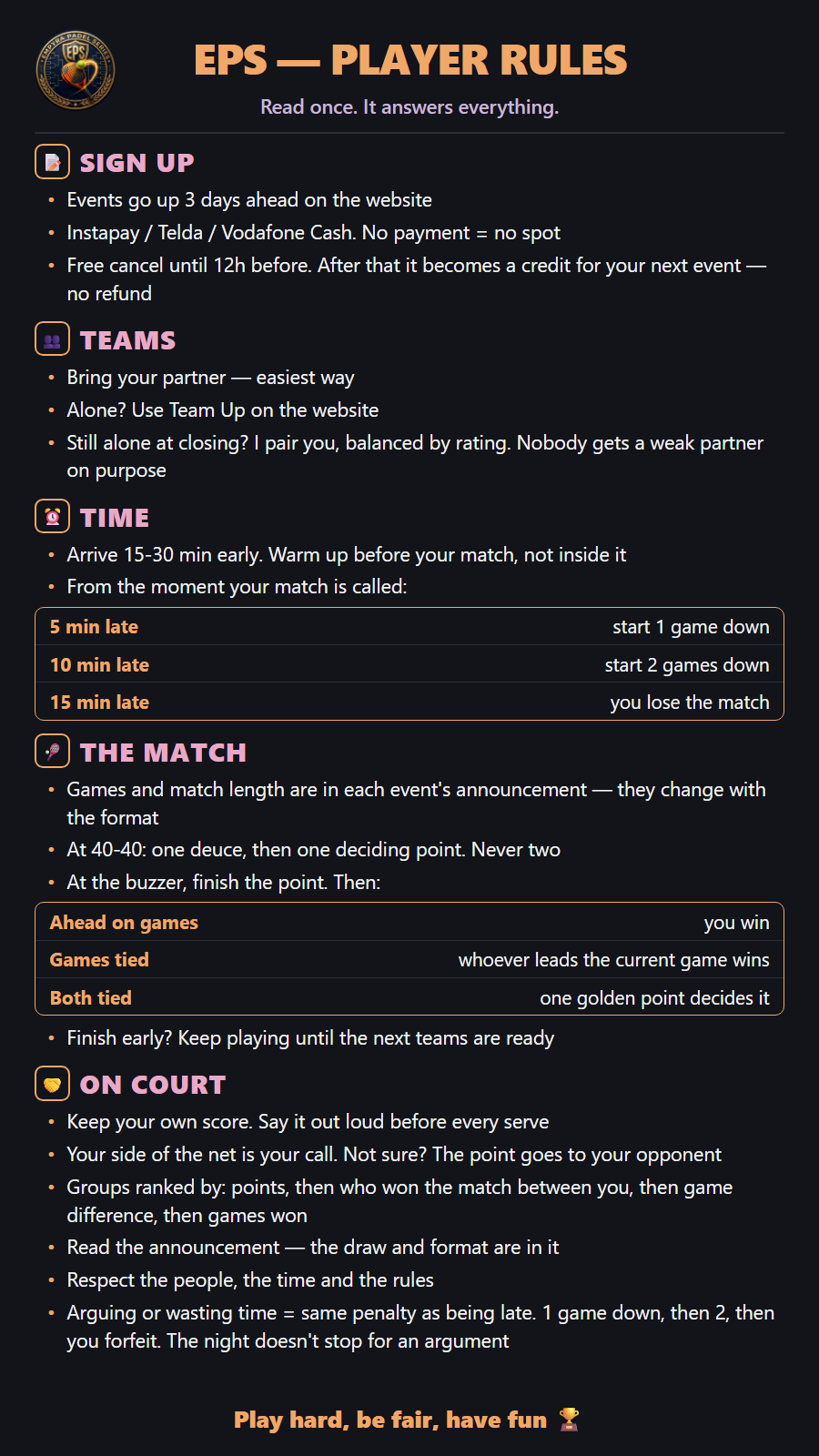
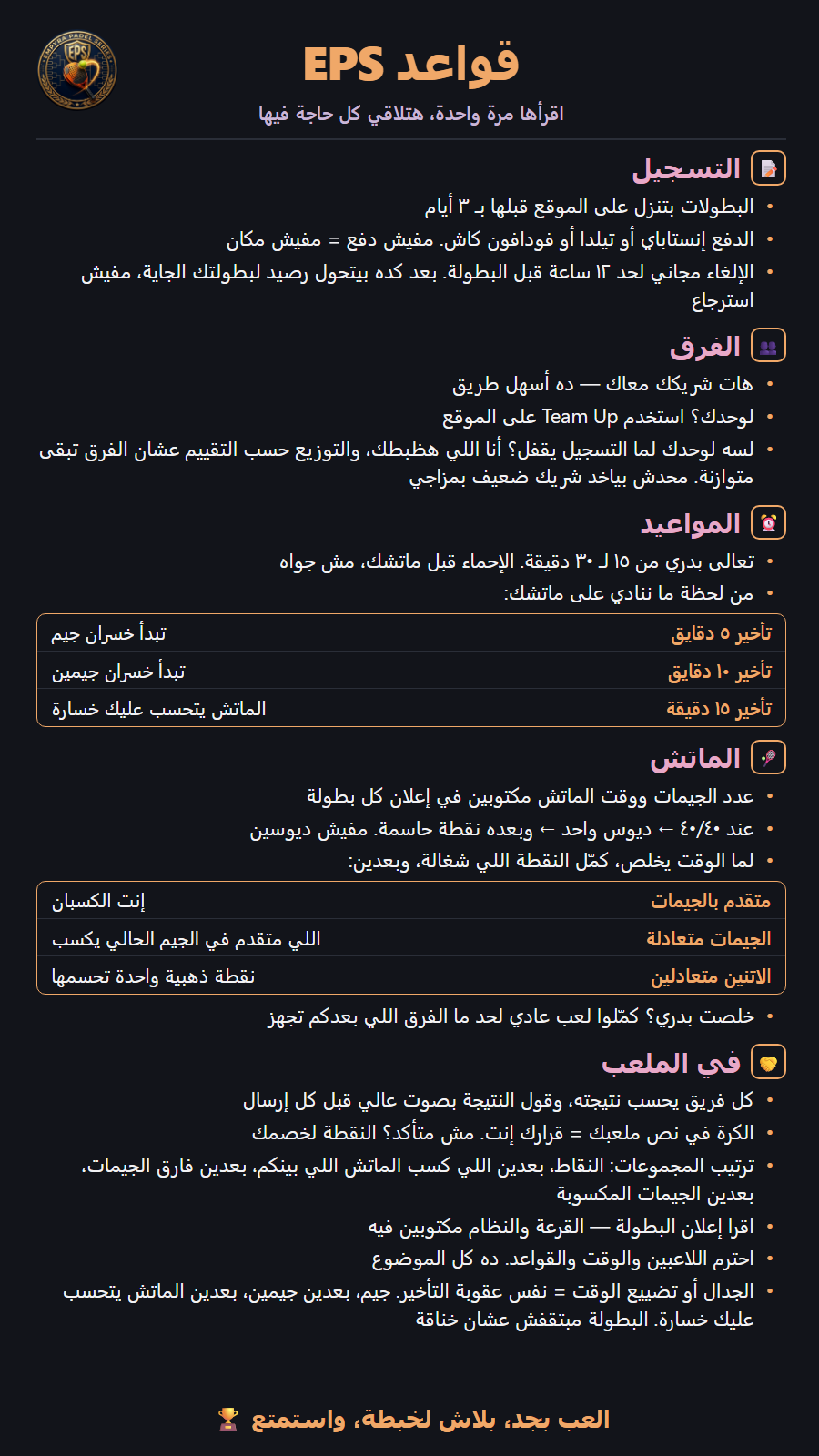
At 40-40: one deuce, then one deciding point — never two.
At the buzzer, finish the point in play, then: ahead on games wins — games
tied, whoever leads the current game wins — both tied, one
golden point decides it.
Finished early? Keep playing until the next teams are ready.
ON COURT
Keep your own score and call it out loud before every serve.
Your side of the net is your call — unsure means the point goes to your
opponent.
Groups are ranked by points, then head-to-head, then game difference, then games won.
Arguing or wasting time carries the same penalty as being late.
Match length and games to win are on each event's poster
— they change with the format.